Modular part kits
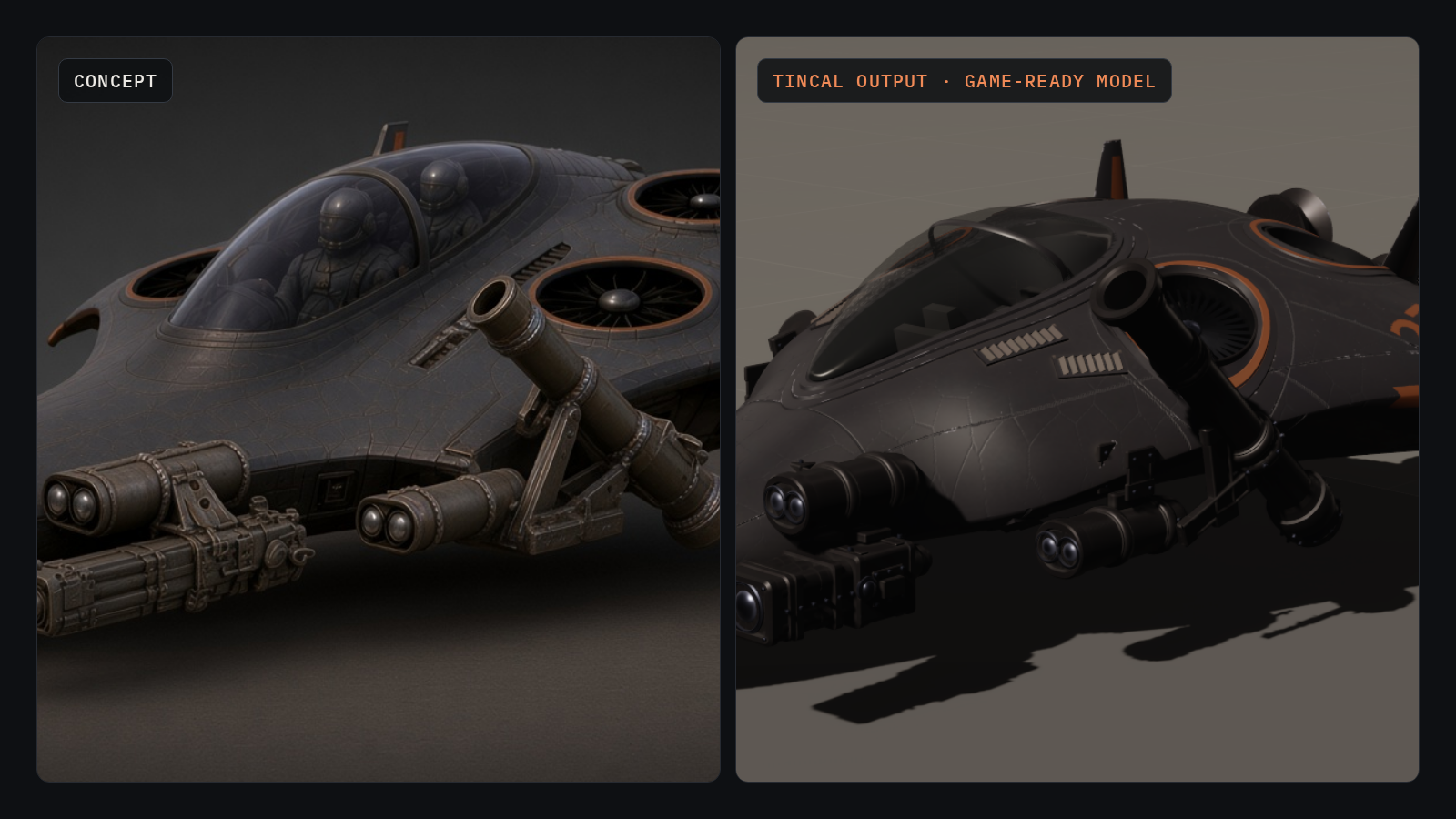
Every part is generated on its own at full resolution, so barrels, pods and blades stay crisp instead of fusing into the body. A part tree checks that nothing is missing.
Regia suite · Asset pipeline
Tincal turns a concept image, plus an optional prompt, into a kit of reusable parts. It generates each part at full quality, assembles the kit, then rigs and validates it, and exports glTF that follows Regia Engine's conventions.
What it does
Every part is generated on its own at full resolution, so barrels, pods and blades stay crisp instead of fusing into the body. A part tree checks that nothing is missing.
Real-world scale, part pivots and joints, sockets, damage states and physics metadata, exported the way Regia Engine expects them.
A canopy is its own part with a transmission material and a cockpit behind it. Colours come from material IDs, and decals come from vector art.
People use the Tincal desktop app, built on Regia Engine. Agents use the tincal command line and MCP server, where every command prints one JSON object.
How it works
Pre-alpha
Tincal is in pre-alpha, and access is by invite. We read every request and look at the applicant's public GitHub work (repositories, recent activity and what they build) to decide who gets in first.
Good to know
Tincal is not public yet. Request an invite below; every request is reviewed by hand.
Tincal sends its logs and crash reports to its developer so failures get fixed. Your concept images, meshes, textures and renders are never sent, and neither are secrets or passwords.
Tincal's exports follow Regia Engine's asset conventions, and the desktop app runs on the engine itself.
The name. Tincal is raw, unrefined borax, the classic smelting flux. It strips the impurities out of concept art (captions, scale figures, melted geometry, garbled glyphs) and protects the design intent all the way to the finished asset.